
Prime rate falls to 15.5% after 9% cut in 2025, lowest in 4 years
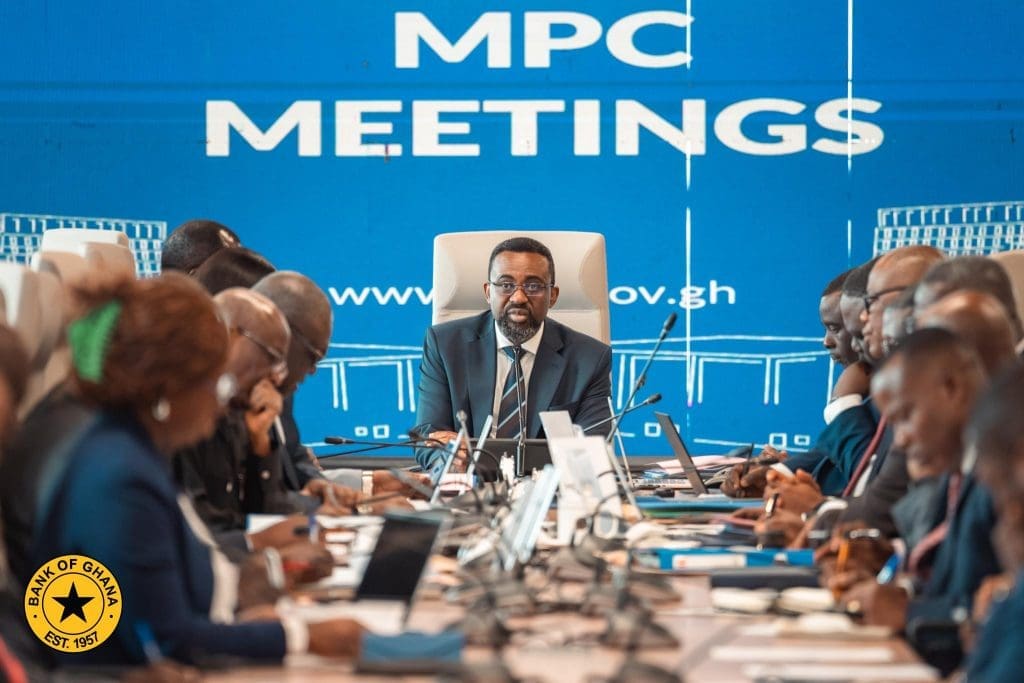
BoG MPC meeting
Ghana’s economic performance in 2025 marks a decisive turning point from the macroeconomic instability, such as the prime rate that characterised the period between 2022 and 2023, with key indicators pointing to a year of stabilisation, consolidation and early recovery.
At the centre of this shift is prime rate, where the Bank of Ghana recorded its lowest Monetary Policy Rate (MPR) in four years, cutting the benchmark rate by 250 basis points to 15.5%.
This move, announced at the 128th Monetary Policy Committee (MPC) press briefing, reflects growing confidence that inflationary pressures have been decisively tamed and that the economy has entered a more stable phase.
The significance of the 15.5% prime rate becomes clearer when placed in historical context.
The last time Ghana’s policy rate was lower was in July 2021, when it stood at 13.5%, before a series of aggressive hikes pushed the rate to a peak of 30% in September 2023.
Those increases were a direct response to surging inflation, currency depreciation and fiscal slippages.
By contrast, the steady easing of rates through 2024 and into early 2026 signals that the emergency phase of macroeconomic management has ended.
In practical terms, this shift reduces the cost of borrowing across the economy and creates space for businesses to invest, expand production and hire workers.
The cumulative 900-basis-point reduction in the prime rate during 2024 translated into a sharp decline in average lending rates, which fell from 30.25%to 20.5%.
This reduction is particularly important for Ghana’s private sector, which has long struggled with prohibitively high credit costs.
Lower lending rates improve access to finance for small and medium-sized enterprises, enhance cash flow for existing firms and support credit expansion, all of which are critical for sustained economic growth rather than short-term stabilisation alone.
The Bank of Ghana’s stated intention to shift focus from crisis management to growth consolidation underscores this transition.
With macroeconomic stability “largely achieved,” policy emphasis has moved toward strengthening the real sector, improving financial intermediation and supporting job creation. This reflects a broader recognition that stabilisation, while necessary, is insufficient unless it translates into tangible improvements in incomes, employment and productive capacity.
Inflation performance in 2025 provides one of the clearest indicators of economic progress.
Headline inflation declined sharply from 23.8% in December 2024 to 5.4% by December 2025.
This dramatic disinflation is not merely a statistical improvement but a fundamental restoration of price stability. Lower inflation preserves purchasing power, stabilises household consumption and reduces uncertainty for businesses planning investment decisions.
Importantly, the Bank of Ghana describes the disinflation process as broad-based, meaning it was not driven by a single factor but supported by tight monetary policy, fiscal discipline and currency appreciation.
Inflation expectations also became more firmly anchored during the year.
Forecasts and surveys indicate that headline inflation is expected to remain within the Bank of Ghana’s medium-term target band of eight per cent, plus or minus two percentage points.
This anchoring is crucial, as expectations often shape wage demands, pricing behaviour and investment decisions. However, the Bank remains alert to potential risks, including upward adjustments in utility prices and volatility in global commodity markets, which could reintroduce inflationary pressures if not carefully managed.
Fiscal performance in 2025 strongly reinforced monetary stability.
Government operations up to November 2025 reflected continued fiscal consolidation, with the overall fiscal deficit on a commitment basis narrowing to just 0.5% of GDP, far below the original target of 3.5%.
This outcome signals a significant improvement in fiscal discipline and expenditure control, helping to reduce pressure on domestic borrowing and complementing the disinflationary stance of monetary policy.
Even more striking was the primary balance, which recorded a surplus of 2.8% of GDP, compared with a target of 0.6 per cent.
A primary surplus indicates that government revenues exceeded non-interest expenditures, a key requirement for stabilising and reducing public debt.
As a result, Ghana’s public debt declined sharply to 45.5% of GDP by the end of November 2025, down from 63.1% a year earlier.
This reduction strengthens debt sustainability, improves investor confidence and enhances Ghana’s creditworthiness in both domestic and international markets.
Economic growth data further confirm the recovery narrative. According to the Ghana Statistical Service, real GDP expanded by 6.1% during the first three quarters of 2025, compared with 5.8% over the same period in 2024.
While the increase may appear modest, it reflects growth achieved under tight policy conditions and fiscal consolidation, suggesting improved productivity rather than stimulus-driven expansion.
Growth was largely driven by the services and agriculture sectors, highlighting a gradual broadening of economic activity beyond traditional extractive industries.
Global economic conditions in 2025 also played a supportive role.
Headline inflation in major economies moved closer to central bank targets, driven by declines in oil and food prices and easing underlying inflation.
Global financing conditions improved considerably, supported by expectations of policy easing by major central banks, increased investor risk appetite and a weaker US dollar.
These developments reduced external financing pressures on Ghana, supported capital inflows and contributed to the appreciation of the cedi against major trading currencies.
Taken together, Ghana’s economic performance in 2025 reflects a year of consolidation after crisis, where stabilisation policies began yielding measurable dividends.
The combination of low and falling inflation, improving fiscal balances, declining public debt, easing interest rates and steady GDP growth suggests that the economy has moved onto a more sustainable footing.
While risks remain, particularly from global shocks and domestic price adjustments, the data indicate that 2025 was a foundational year in rebuilding macroeconomic credibility and setting the stage for stronger, more inclusive growth in the years ahead.
About The Author