SOEs’ equity shrinks GH¢12.69bn, operating profit falls 22.7%
By ELVIS DARKO, Accra
The financial health of Ghana’s State-Owned Enterprises (SOEs) weakened significantly in 2025, with key indicators of financial stability—including equity, assets, operating profit, operating margin and the quality of earnings—recording notable deterioration, raising fresh concerns about the ability of state companies to absorb financial shocks and limit their demands on the public purse.
Although the sector reported a headline aggregate profit of GH¢19.8 billion for the 2025 financial year, the apparent improvement was heavily influenced by currency revaluation gains.
Excluding that effect, aggregate profit fell by GH¢1.67 billion, from GH¢9.75 billion in 2024 to GH¢8.08 billion, representing a 17.1% contraction.
The deterioration means that beneath the headline profit figure, the underlying financial performance of the SOE portfolio was considerably weaker than the reported numbers suggest.
At the same time, aggregate equity—a critical measure of the sector’s balance-sheet strength and capacity to withstand losses—fell by GH¢12.69 billion, or 9.16%, to GH¢125.852 billion from GH¢138.541 billion in 2024.
The decline in equity points to a shrinking financial buffer available to state enterprises to absorb operational losses, rising costs, debt obligations and other risks.
It also leaves the Government with a potentially greater fiscal exposure should financially distressed entities require additional capitalisation, guarantees or other forms of support.
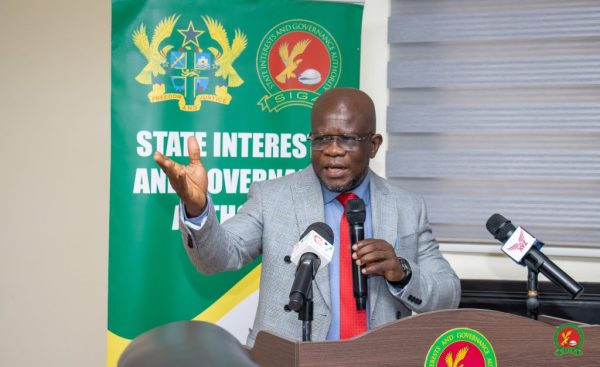
The findings are contained in the 2025 State Ownership Report (SOR) released by the State Interests and Governance Authority (SIGA), which provides an assessment of the financial and operational performance of Ghana’s state-owned and state-linked entities.
Operating performance weakens
The deterioration was also evident in the core operating performance of the SOE sector.
Aggregate operating profit declined by 22.7% during the year, while the operating margin also fell by 3.5% compared with 2024.
The weakening of operating profitability is significant because it points to pressure on the underlying businesses themselves, rather than merely movements in financial or non-operating items.
An operating profit measures the earnings generated from an entity’s principal activities before financing and certain other items are taken into account.
A declining operating margin, meanwhile, indicates that companies are retaining less operating income from their revenues.
Consequently, the deterioration in these measures suggests that the increase in headline revenue did not translate proportionately into stronger operating performance.
The sector’s aggregate revenue increased from GH¢137.642 billion in 2024 to GH¢176.432 billion in 2025, representing growth of 28.12%.
While that increase remains substantial, it was slower than the 30.56% expansion recorded in 2024, when aggregate revenue rose from GH¢105.474 billion to GH¢137.642 billion.
The combination of slower revenue growth and falling operating profitability raises questions about cost pressures, efficiency and the ability of SOEs to convert higher turnover into sustainable earnings.
Asset base contracts
Another major deterioration occurred in the aggregate asset base of the SOE sector. Total assets declined by 5.86%, from GH¢433.247 billion in 2024 to GH¢407.848 billion in 2025.
This represented a sharp reversal from 2024, when the sector’s asset base had expanded by 26.99%.
SIGA attributed the contraction largely to the performance of major entities including the Electricity Company of Ghana (ECG), the Volta River Authority (VRA) and the Ghana Cocoa Board (COCOBOD).
The decline in assets, combined with the reduction in equity, points to a contraction in the overall financial capacity of the SOE portfolio.
SIGA consequently warned that the sector entered 2026 with weaker balance sheets to cushion increasing fiscal risks to the Government.
The concern is particularly important because losses or balance-sheet weaknesses at strategically important SOEs can ultimately migrate to the public sector through government guarantees, direct financing, debt restructuring, recapitalisation or delayed payments to suppliers.
Total liabilities also declined, falling by 4.31% to GH¢281.99 billion. ECG alone accounted for GH¢82.31 billion of the liabilities recorded across the portfolio, underscoring the extent to which the power utility remains a major source of financial exposure within the state enterprise sector.
Currency gains mask underlying weakness
The cedi’s performance in 2025 provided considerable relief to SOEs through its impact on foreign currency exposures and finance costs.
According to SIGA, the improved exchange-rate environment reduced the finance cost burden of SOEs by 42.49%.
The sector moved from recording a net foreign exchange loss of GH¢12.01 billion in 2024 to a net foreign exchange gain of GH¢11.72 billion in 2025.
That turnaround had a major influence on the sector’s reported bottom line and explains why headline aggregate profit more than doubled despite deterioration in several core operating indicators.
The figures therefore provide an important distinction between accounting gains arising from currency movements and the underlying performance of the enterprises.
Without the currency revaluation effect, the sector would have recorded a significant decline in aggregate profit rather than the reported increase.
This makes the 17.1% fall in underlying profit one of the most important indicators in assessing the actual financial health of the SOE portfolio.
GETFund booking raises questions
The report also highlights an unusual component of the sector’s reported earnings, with GH¢4.128 billion in Ghana Education Trust Fund (GETFund) money booked as profit.
The inclusion of the amount in profit raises questions about the quality and sustainability of earnings reported by the affected entity or entities, particularly when assessing whether the sector’s improved headline profitability was generated from normal commercial operations.
The development further reinforces the need to distinguish between recurring operating earnings and accounting entries or transfers that may not represent sustainable income from the core operations of state enterprises.
Chronic loss-making entities
Despite the aggregate figures, several SOEs remain trapped in persistent financial distress. SIGA identified five entities that recorded losses in every year from 2021 through 2025.
They are ECG, Ghana Cylinder Manufacturing Company Ltd, GNPA Ltd, Graphic Communications Group Company and Ghana Digital Centre.
The persistence of losses across a five-year period points to structural rather than temporary financial difficulties.
The report also identified six entities that had negative equity throughout the same five-year period.
These included AirtelTigo Ghana Ltd, GIHOC Distilleries and Tema Oil Refinery.
Negative equity occurs when accumulated liabilities exceed the value of an entity’s assets, leaving the company with a balance-sheet deficit and severely limiting its capacity to finance operations without external support.
For government-owned companies, persistent negative equity creates a direct or contingent fiscal risk because the state may ultimately have to intervene to preserve strategic operations, protect jobs or meet obligations to creditors.
Dividend returns remain extremely low
Despite the size of the SOE portfolio and the large volumes of revenue generated, direct dividend returns to Government remained remarkably small.
Only two fully state-owned enterprises—Ghana Reinsurance Company Ltd and TDC Company Ltd—paid dividends to Government during 2025, with combined payments of GH¢16 million. That represented a 29.36% decline from the previous financial year.
The weak dividend performance is particularly striking when measured against the scale of the sector’s revenues and asset base.
It suggests that the state continues to carry substantial commercial assets without receiving commensurate returns from a large proportion of its fully owned enterprises.
In effect, the Government remains exposed to the costs and risks associated with ownership while receiving relatively limited direct financial returns from many of the companies.
The report separately recorded only US$1.4 million in dividends from the 53 fully state-owned enterprises.
Other State Entities face deeper crisis
The financial pressures were even more pronounced among OSEs, where the aggregate net deficit widened dramatically during the year.
The deficit reached GH¢10.48 billion in 2025, compared with GH¢2.18 billion a year earlier. The deterioration occurred despite a substantial expansion in the sub-sector’s asset base.
Total assets grew by 60.15% to GH¢310.62 billion, but liabilities increased at an even faster pace, rising by 41.83% to GH¢323.17 billion.
The result was a dramatic deterioration in the accumulated fund position. The sub-sector moved from an accumulated positive fund of GH¢15.47 billion in 2024 to a negative position of GH¢41.14 billion in 2025.
SIGA attributed much of the shift to the Bank of Ghana’s negative equity position of GH¢93 billion.
The development illustrates the difficulty of assessing the financial health of the broader state ownership portfolio solely through the performance of conventional commercial SOEs.
The inclusion of institutions with fundamentally different mandates and balance-sheet structures can have a substantial effect on aggregate figures.
Joint ventures provide stronger returns
The Joint Venture Companies (JVCs) presented a markedly different picture from the fully state-owned enterprises and Other State Entities.
Their aggregate assets reached GH¢96.69 billion during 2025, while net profit excluding minority interests increased from GH¢2.29 billion in 2024 to GH¢3.14 billion.
The strongest performance came from JVCs with minority interests, whose net profit surged to GH¢61.32 billion from GH¢21.06 billion in the preceding year.
These companies also emerged as the dominant source of dividends flowing to Government from the wider state portfolio.
They contributed GH¢1.19 billion in dividends, representing 97.12% of all dividends received across the portfolio. The contrast is significant.
While fully state-owned enterprises generated substantial revenues but delivered minimal dividends, companies in which the state has minority interests produced the overwhelming majority of dividend income.
That disparity raises broader questions about the efficiency of state ownership structures and whether Government should reconsider the way it manages its commercial interests, including the possibility of strengthening governance, profitability requirements and return-on-investment benchmarks.
Agriculture, manufacturing and infrastructure support growth
Notwithstanding the financial weaknesses, SIGA reported that the agriculture, manufacturing and infrastructure sub-sectors made significant contributions to growth during the year.
Their performance helped support the broader expansion of activity across the state enterprise portfolio, even as profitability, margins and balance-sheet strength deteriorated in several areas.
The report covers 162 specified entities, comprising 53 SOEs, 36 Joint Venture Companies and 73 Other State Entities.
It provides a comprehensive assessment of their financial and operational performance and is intended to serve as a reference for policymakers, stakeholders and the public in shaping the future management of Ghana’s state-owned and state-linked enterprises.
Fiscal risks remain the central concern
The most significant message emerging from the 2025 performance is that stronger headline profitability should not be interpreted as a broad-based improvement in the financial health of Ghana’s state enterprises.
The sector generated higher reported profit largely because of favourable currency movements, while underlying profit fell. Equity contracted, assets declined, operating profit weakened and operating margins narrowed.
At the same time, several enterprises remained chronically loss-making, while others continued to operate with negative equity.
The exceptionally low dividend contribution from fully state-owned companies further highlights the imbalance between the resources committed to state ownership and the financial returns accruing to Government.
The situation is compounded by the concentration of liabilities in major strategic entities such as ECG, where the scale of obligations means financial problems can have implications far beyond the company itself.
For Government, the deterioration in equity is perhaps the most important warning sign. A smaller aggregate equity base means the SOE sector has less internal capacity to absorb shocks before financial difficulties begin to translate into demands on the national budget.
READ ALSO: Cocoa Bills: COCOBOD pays GH¢2.3bn DDEP claims
The 2025 State Ownership Report therefore presents a mixed picture: revenue continued to expand and currency gains transformed the sector’s reported bottom line, while the underlying indicators of financial resilience and operating efficiency weakened.
The challenge for Government and SIGA will be to ensure that the improvement in headline earnings does not obscure the deeper structural weaknesses within the state enterprise portfolio.
Without reforms capable of improving operational efficiency, strengthening corporate governance, addressing chronic losses and ensuring that state assets generate adequate returns, the financial weaknesses of SOEs could continue to represent a significant and growing fiscal risk to the Government and, ultimately, taxpayers.
About The Author