Mahama, Steinmeier push new era of Africa-Germany business
By ELVIS DARKO, Accra
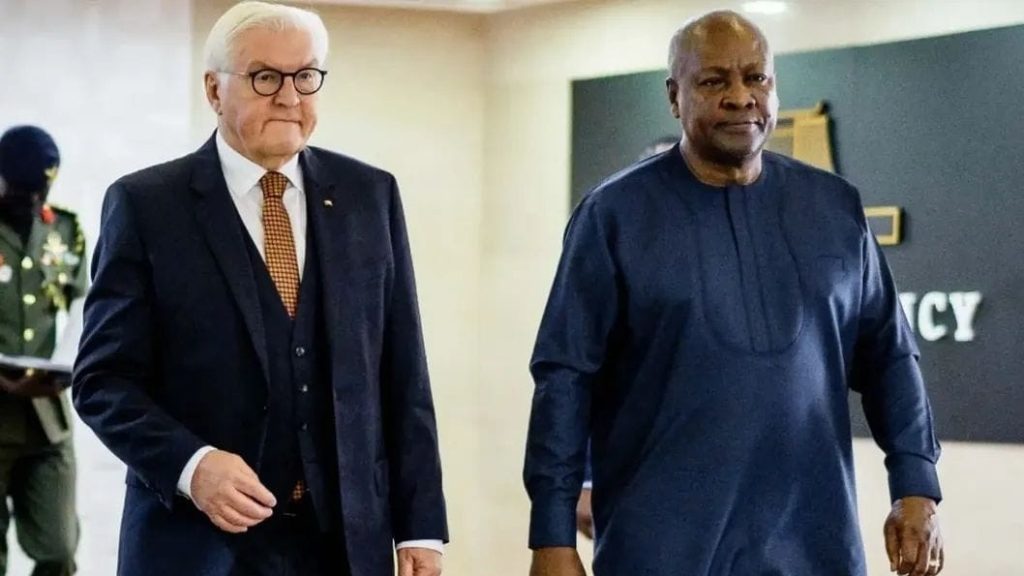
President John Dramani Mahama and German President Frank-Walter Steinmeier urged businesses to deepen economic ties between Germany and Africa, calling for more trade, investment, technology transfer and industrial development.
Opening the sixth German-African Business Summit (GABS) in Accra, the two leaders made their case to political leaders, policymakers, executives, investors and development partners from Germany and across Africa.
The summit, Germany’s premier business and investment event on the continent, was organised by the Sub-Saharan Africa Initiative of German Business (SAFRI) and the Delegation of German Industry and Commerce in Ghana. Its agenda spans energy, infrastructure, manufacturing, agriculture, logistics, finance and digital transformation.
Mahama said Africa and Germany should move beyond traditional development assistance towards partnerships built on trade, industry, investment, technology and the processing of local resources.
Global uncertainty, technological change and shifting supply chains, he said, give Africa an opening to become a competitive base for investment, manufacturing and innovation.
“Africa has the natural resources, the youthful population and expanding consumer markets,” he said, but the continent must turn those advantages into enterprises that create decent jobs and lasting prosperity.
“We must process what we produce. We must manufacture what we consume, and compete effectively in regional and global markets.”
Germany’s strengths in engineering, advanced manufacturing, innovation and vocational training, Mahama said, could complement African economies’ efforts to build industrial capacity.
He urged German firms to pair their technology and expertise with African resources, entrepreneurship and growing markets to establish commercially viable businesses.
Ghana positions itself as a gateway
Mahama presented Ghana as a potential entry point to the continent, pointing to the African Continental Free Trade Area (AfCFTA) Secretariat in Accra.
The agreement connects a market of about 1.4 billion people with combined GDP exceeding US$3.5 trillion.
In West Africa alone, he said, the market encompasses about 400 million people. Investors, he urged, should see Africa as an increasingly connected place to produce and trade, rather than as a collection of separate national markets.
Brands such as Simmons, Heidelberg and Mercedes-Benz, he said, could use Ghana as a hub to reach other African countries through the AfCFTA’s tariff-free trade arrangements.
Mahama cited Ghana’s economic figures as signs of renewed stability. The economy grew 6 per cent in 2025, with year-on-year growth also at 6 per cent in the second quarter of 2026.
Inflation fell from 23.8 per cent in December 2024 to 5.2 per cent in September 2026. International reserves rose from US$8.9 billion in December 2024 to about US$12.94 billion in June 2026.
Ghana’s GDP, he said, had passed US$100 billion, making it Africa’s eighth-largest economy and West Africa’s second-largest.
Under its New Economy Programme, the government plans to invest US$10 billion between 2027 and 2030 in agriculture, agro-processing, manufacturing, energy, infrastructure, pharmaceuticals, tourism, creative industries, digital innovation and mineral processing.
The programme is intended to move exports beyond raw materials. Mahama said Ghana traditionally exports raw materials and agricultural products to Germany, while importing machinery, chemicals and manufactured goods.
“We think that we should be adding more value to our exports in order to create more jobs locally for our people,” he said.
Trade, financing and jobs
Mahama also highlighted Ghana’s trade ties with Germany and the European Union.
Ghana’s exports to the EU rose 23.2 per cent in 2025, producing a trade surplus of €418 million that year.
In bilateral trade with Germany, he said, exports had increased and the surplus was in Ghana’s favour.
Germany announced about €65 million in development cooperation during Steinmeier’s visit to Ghana in 2025, supporting governance, energy, technical education and economic development.
Mahama said Ghana wanted to work with German financial institutions, development finance organisations, export credit agencies and commercial banks to structure financing for viable projects.
He cited KfW, DEG and Germany’s export credit guarantee system as parts of that financing network.
As an example of the impact, he praised KfW’s support for the North Shore Apparel Factory in Savelugu, in Ghana’s Northern Region.
With financing from KfW and support from Ghana’s Exim Bank, the factory now employs more than 2,000 young people, 80 per cent of them female.
Mahama said the jobs had enabled many young people to remain in the north instead of moving south to take menial work in urban centres.
He called for the summit to produce concrete business-to-business links, project development, investment matchmaking and follow-up.
Steinmeier calls for investment and stronger ties
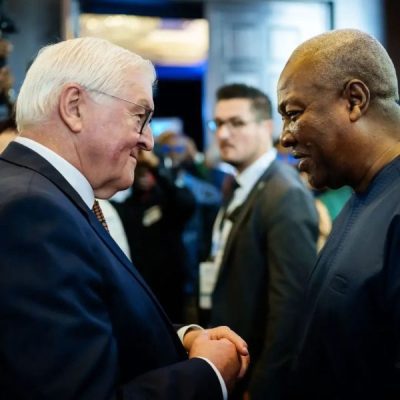
Steinmeier said Germany and Africa needed each other more than ever to confront climate change, poverty, food insecurity and the rapid changes driven by artificial intelligence.
Visits to Africa over the past two decades, he said, had strengthened his belief in the continent’s entrepreneurial potential, especially among young people.
He urged German businesses to be curious, take risks and invest in a shared future. Geopolitical developments, he said, had made it clear that Germany must diversify its traditional export markets and build stronger economic partnerships.
Germany-Africa trade rose by about 10 per cent in the previous year, reaching a record, but substantial opportunities remained untapped.
Steinmeier encouraged African governments to pursue economic reforms, ease trade and strengthen regional integration.
He described the AfCFTA as an important step towards greater integration and prosperity. Reliable partnerships, he added, matter beyond commerce: they can also support the international rules-based order. Africa should have greater representation and a stronger voice in international organisations, particularly the United Nations, he said.
At bilateral talks in Accra, Mahama described Ghana-Germany relations as being at a “very good level” and said he wanted to elevate the partnership further.
The countries signed important political agreements in 2025 and held political consultations, he said. Ghana had also signed its bilateral debt agreement with Germany after Steinmeier’s previous visit.
Despite “some humps,” Mahama said, Ghana was making progress with debt restructuring. The two governments were working on a joint declaration of intent for regular consultations between their foreign ministers.
Mahama thanked Germany for supporting the Kofi Annan International Peacekeeping Training Centre, which trains personnel from across West Africa and beyond.
With violent extremism affecting the subregion, Ghana, he said, was working to improve ties between ECOWAS and Sahelian states through a special envoy.
He said Germany and the European Union were concerned about stability in the area and urged Steinmeier not to give up on the Sahelian states. Ghana, he added, was ready to work with Germany to help address violent extremism.
READ ALSO: Aaron Kanor rewriting GRA Customs’ revenue story
Steinmeier expressed hope that the summit would again serve as an engine for closer business cooperation between Germany, Ghana and other African partners.
SAFRI Chairman Thomas Schäfer said relations had reached a decisive moment: both sides needed to turn longstanding goodwill and diplomatic engagement into practical business results.
German companies were seeking growth, resilient markets and reliable partners, he said, while African businesses were expanding across the continent and beyond. He called on German firms to see Africa as a destination for trade, investment and entrepreneurship
About The Author