MCC reopens development talks with Ghana
The Millennium Challenge Corporation (MCC) has opened fresh discussions with Ghana on the possibility of renewing their development partnership, following a high-level meeting with the Millennium Development Authority (MiDA) in New York.
The engagement brought together senior officials of both institutions to review Ghana’s two completed MCC Compacts, assess the lessons and legacy of the programmes and explore areas for possible future cooperation.
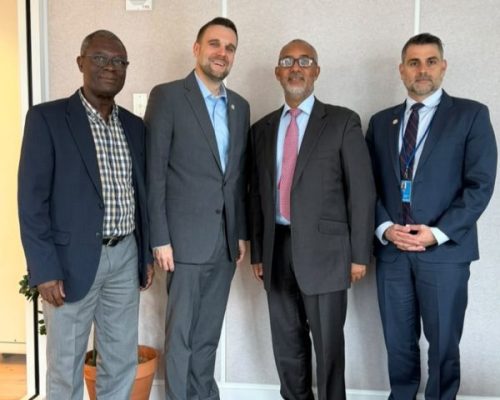
The MiDA delegation was led by its Chief Executive Officer, Alexander Kofi-Mensah Mould, and Board Chairman, Charles Abugre, while the MCC delegation was led by Acting Vice President for Compact Operations, Jason Small, and Senior Policy Advisor, Tariq Ahmed.
MCC assesses what has changed
Mr Small said Ghana’s previous record with MCC would be important should the country seek another Compact.
He said the corporation had strengthened its assessment of prospective partner countries, including examining opportunities for increased United States investment, exports and supply chains involving critical materials and minerals.
For countries with previous MCC programmes, he said the agency would also assess how earlier investments performed, whether programmes were fully implemented and whether reforms and investments had been sustained.
The assessment, he said, would give Ghana an opportunity to demonstrate the institutional and policy improvements made since challenges affected the implementation of the second Compact.
The $498.2 million Ghana Power Compact was signed in 2014 and became effective in September 2016. Following the termination of the ECG-PDS concession in 2019, MCC de-obligated $190 million of the Compact that was conditional on the concession. The remaining programme was implemented through MiDA and formally completed in June 2022.
Energy remains key
Mr Mould said Ghana’s energy sector could provide a platform for renewed cooperation, particularly because of the infrastructure and experience generated by the Power Compact.
He identified opportunities to strengthen the electricity grid, improve distribution company performance and deepen regional electricity integration.
He also highlighted the potential for natural gas infrastructure linking Ghana and Nigeria to support regional power generation and improve electricity reliability.
“We’re looking at the natural gas that we have, and also Nigeria, to see how we can work together — do the pipeline to ensure that we have gas flowing across the region to generate electricity and also to improve the grid,” Mr Mould said.
He cited reforms introduced in the power sector, including quarterly automatic tariff adjustments and a cash waterfall mechanism intended to improve revenue distribution across the electricity value chain.
Regional projects considered
Mr Small said MCC had previously examined regional energy projects, including proposed transmission interconnectors between Ghana and Côte d’Ivoire and Ghana and Burkina Faso.
He said the corporation would need to establish the current status and viability of those projects before considering any renewed intervention.
He stressed that future MCC investments would have to be based on evidence that an identified constraint remained a significant impediment to economic growth.
“There’s still an opportunity,” he said, while indicating that further analysis would be required before determining the sector and nature of any future investment.
New focus on US economic returns
Mr Small said MCC’s assessment framework now also considers “American returns”, including opportunities for increased US investment, exports and supply chains involving critical minerals.
For Ghana, the approach could broaden future discussions around the country’s natural resources, infrastructure and regional position.
However, he stressed that a previous MCC partnership did not automatically guarantee a new Compact, with the MCC Board required to assess available evidence before selecting countries.
Building on MCC legacy
Ghana has completed two MCC-funded programmes: the first Ghana Compact, which supported agriculture, transportation and rural development, and the Ghana Power Compact, which focused on electricity infrastructure and power-sector reforms.
The Power Compact delivered major infrastructure, including four power substations, alongside reforms aimed at improving the reliability and sustainability of the electricity sector.
The New York meeting therefore provides MiDA with an opportunity to build on more than a decade of experience with MCC while demonstrating the reforms and institutional changes Ghana has undertaken since its previous programmes.
The renewed engagement could also open discussions on future national and regional projects, particularly in energy, infrastructure and economic integration.
About The Author