Northshore Apparel opens in Savelugu with over 2,300 jobs
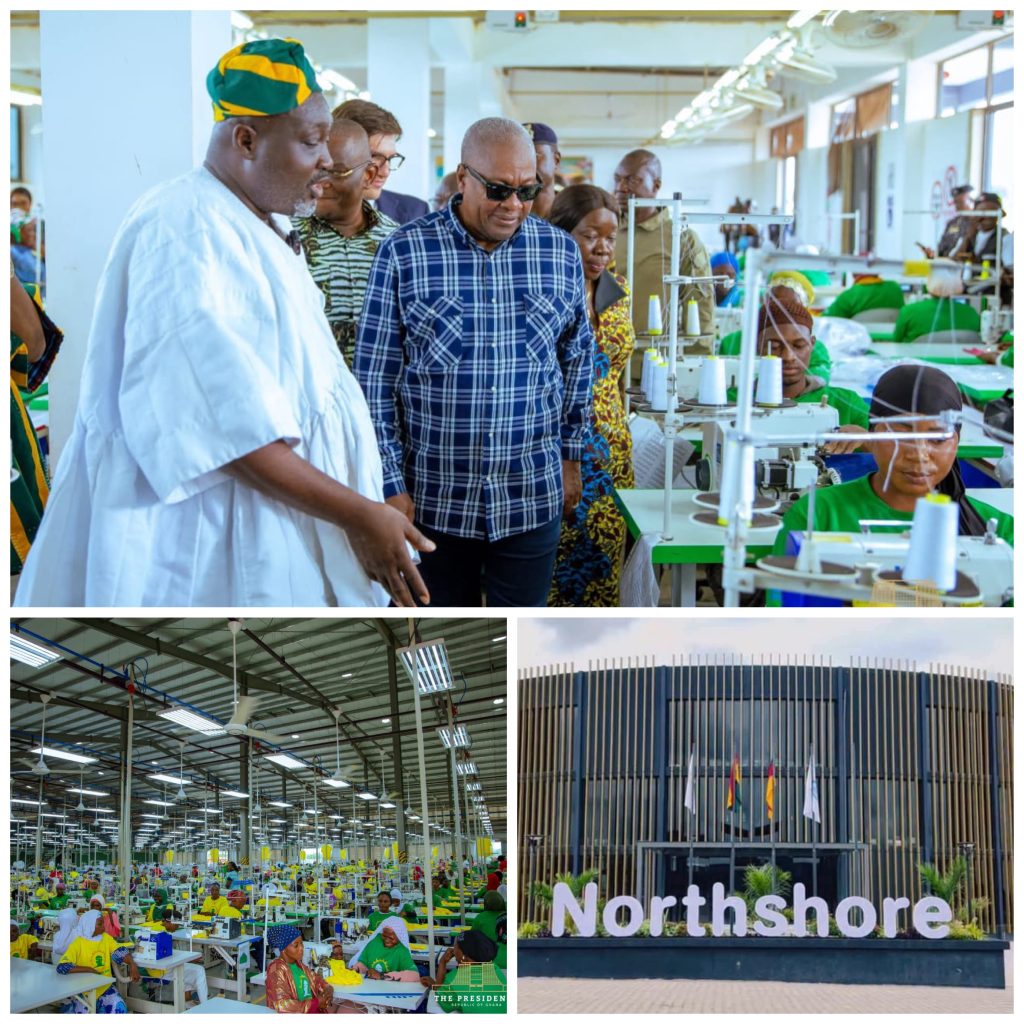
created by photogrid
By ELVIS DARKO, Accra
Northshore Apparel Ghana Limited has been inaugurated at Savelugu in the Northern Region, opening a new chapter in Ghana’s efforts to decentralise industrialisation, expand garment manufacturing and create large-scale employment opportunities outside the traditional industrial centres.
The wholly Ghanaian-owned facility, designed as a globally competitive apparel manufacturing hub, is expected to produce garments for both domestic and international markets, with the bulk of its output targeted at exports.
Already, the factory has created direct employment for more than 2,300 people, making it one of the significant private-sector job-creating investments in the region and a practical example of the industrial expansion envisaged under the Government’s 24-Hour Economy programme.
The company manufactures a range of garments, including sportswear, workwear, children’s clothing and underwear, positioning Savelugu as an emerging production centre within Ghana’s garment and textile value chain.
The project is also distinguished by its environmental and worker-focused infrastructure, with the facility described as Ghana’s first regenerative, zero-waste apparel manufacturing hub.
A major production complex
The scale of the Northshore facility reflects its ambition to compete in the international apparel market.
The factory has 50 sewing lines occupying approximately 5,000 square metres of sewing production space.
It also contains a 4,000-square-metre cutting and design centre, providing capacity for the preparation and development of garments before production.
Another 8,000 square metres has been dedicated to warehousing for raw materials and finished products, creating substantial storage capacity to support continuous manufacturing and export operations.
The infrastructure has been designed not simply as a conventional garment factory but as an integrated industrial facility incorporating energy, water, waste management, healthcare and social amenities.
It has a 500-kilowatt peak solar power system, intended to support its energy requirements while strengthening its environmental credentials.
The factory also has an on-site clinic and crèche, as well as disability-friendly washrooms, facilities intended to improve working conditions and make the workplace more inclusive.
A biodigester has been installed for waste management, reinforcing the factory’s zero-waste production model, while a 600,000-litre underground mechanised water facility provides critical water infrastructure for the operation.
From sod-cutting to production
The development of the factory began with the cutting of the sod in March 2024, setting in motion the construction of what has now become a major manufacturing facility in Savelugu.
The project was championed by a consortium led by MIK Designs and its partner, MUSOF Enterprise, which provided 75% of the project financing.
The remaining 25% was financed by the Facility Investment for Employment (IFE), an investment mechanism created by the German Development Bank, KfW, on behalf of the German Federal Ministry for Economic Cooperation and Development (BMZ).
The project also received financing support from Ghana EXIM Bank and the Agricultural Development Bank (ADB).
The financing arrangement reflects a partnership between Ghanaian institutions and international development finance aimed at promoting productive investment, job creation and improved working conditions.
The IFE forms part of Germany’s broader commitment to employment creation and decent work in its partner countries.
As an integral part of the special initiative, “Decent Work for a Just Transition,” the IFE aims to facilitate the creation of up to 100,000 jobs across eight partner countries, including Ghana.
Mahama: ‘First seed’ of Northern industrial revival
Inaugurating the facility, President John Dramani Mahama described the project as the beginning of efforts to restore Northern Ghana to what he termed its past industrial glory.
He said the establishment of Northshore Apparel had challenged longstanding assumptions about the suitability of the northern part of the country for large-scale industrial development.
“Northshore has made nonsense of all the arguments about factors of production. I remember in secondary school I did economics, and we have what they call the factors of production,” the President said.
He explained that the traditional factors considered by investors when choosing locations for factories included access to raw materials, markets, proximity to ports, reliable power and water.
According to him, the absence or perceived inadequacy of some of these factors had historically caused many industrialists scouting for locations in Ghana to overlook the north.
But Northshore, he argued, had demonstrated that such assumptions could be overcome.
President Mahama said Northern Ghana had the conditions necessary for industrial development, including access to land that was relatively free from litigation.
He commended Alhaji Nurudeen Mohammed, Chief Executive Officer of Northshore Apparel Ghana Limited, and his partners for their contribution to the development of the facility.
The President said targeted and impactful financing of projects of this nature could provide jobs for Ghana’s growing youth population while simultaneously expanding the productive capacity of the economy.
24-Hour Economy put to work
President Mahama positioned Northshore Apparel as a practical demonstration of his administration’s 24-Hour Economy vision.
“This is an example of what our vision—the 24-Hour Economy in each city—is meant to do. Northshore is going to run several shifts, and it means that several young people would get jobs to do,” he said.
He explained that the factory’s multiple-shift operations would allow production to continue beyond conventional working hours, increasing the utilisation of the facility while creating additional employment.
The President said other factories were also being developed with similar plans to operate multiple shifts and generate opportunities for Ghanaian businesses and workers.
For him, Northshore demonstrates that the 24-Hour Economy can translate into tangible outcomes in the form of employment, manufacturing and exports.
He said the broader economic transformation agenda was designed to promote job creation and accelerated exports, both of which he said were being achieved by Northshore.
The factory, he noted, had already created at least 2,000 jobs, while a significant proportion of its products would be exported to generate foreign exchange for Ghana.
30,000 jobs targeted
President Mahama said the ambitions for the project extend well beyond the more than 2,300 direct jobs already created.
He disclosed that the facility would form part of what he called the Northshore Industrial Hub, which, when operating at full strength, could provide employment to at least 30,000 young people across Northern Ghana.
“This is going to become a major employment and job creation centre for the whole of Northern Ghana,” he said.
“We believe that at full strength, this hub which we have named the Northshore Industrial Hub, will be able to provide employment to at least 30,000 young people, and reduce the north-south migration.”
The proposed expansion, he said, could help address one of the region’s longstanding challenges—the migration of young people to southern Ghana in search of employment.
Tackling north-south migration
President Mahama linked the industrial project to the broader challenge of uneven economic development between northern and southern Ghana.
He recalled that Ghana’s review under the African Peer Review Mechanism (APRM) had identified the lack of economic opportunities in northern Ghana as a key factor contributing to population imbalance.
He said young people who completed their education in the north but found limited employment opportunities were often compelled to migrate south.
“When students finished school and they had no opportunity, they just picked their bags, boarded a vehicle to go to the south,” he said.
Such migration, he explained, puts additional pressure on social services in the southern parts of the country, including housing, transport, health and other public infrastructure.
He cited the APRM recommendation for Ghana to pursue a more balanced pattern of development between the north and south by deliberately creating more opportunities in northern communities.
“And create more opportunities in the north so that people will remain here. And I believe that this is the beginning of what the peer review mechanism was talking about,” he said.
Traditional authority backs industrial development
The President also expressed gratitude to Yoo Naa Abdulai Yakubu Andani, Paramount Chief of Savelugu, for making land available for the project and supporting plans for additional industries in the area.
The availability of land and cooperation from traditional authorities, he suggested, would help create the conditions for further industrial investment in Savelugu.
The expectation is that Northshore Apparel will serve as an anchor investment around which other businesses and industries can develop, creating additional opportunities across the supply chain.
Ghana EXIM Bank eyes global garment market
Chief Executive Officer of Ghana EXIM Bank, Sylvester Mensah, said the inauguration of Northshore Apparel would strengthen Ghana’s position in the global garment market.
The project represents an effort to move Ghana beyond the export of raw materials by developing local manufacturing capacity and producing finished goods for international markets.
With its extensive production, design and warehousing facilities, the factory has the potential to integrate Ghana more deeply into the international apparel value chain while generating foreign exchange through exports.
The combination of Ghanaian ownership, local employment, development finance and export-oriented manufacturing also gives the project a strategic significance beyond Savelugu.
Its success could demonstrate that large-scale, globally competitive manufacturing can be established in northern Ghana, while providing a template for using industrial investment to create jobs, reduce regional inequality and curb the migration of young people in search of opportunities.
READ ALSO:
For the Mahama administration, Northshore Apparel is consequently being presented as more than a garment factory.
It is an early physical expression of the 24-Hour Economy, an export platform, an employment engine and the proposed foundation of a much larger industrial hub intended to reshape the economic prospects of Northern Ghana.
About The Author